
Wayne Thiebaud Lectures on Art and Drawing

Unable To View Images? Click Here
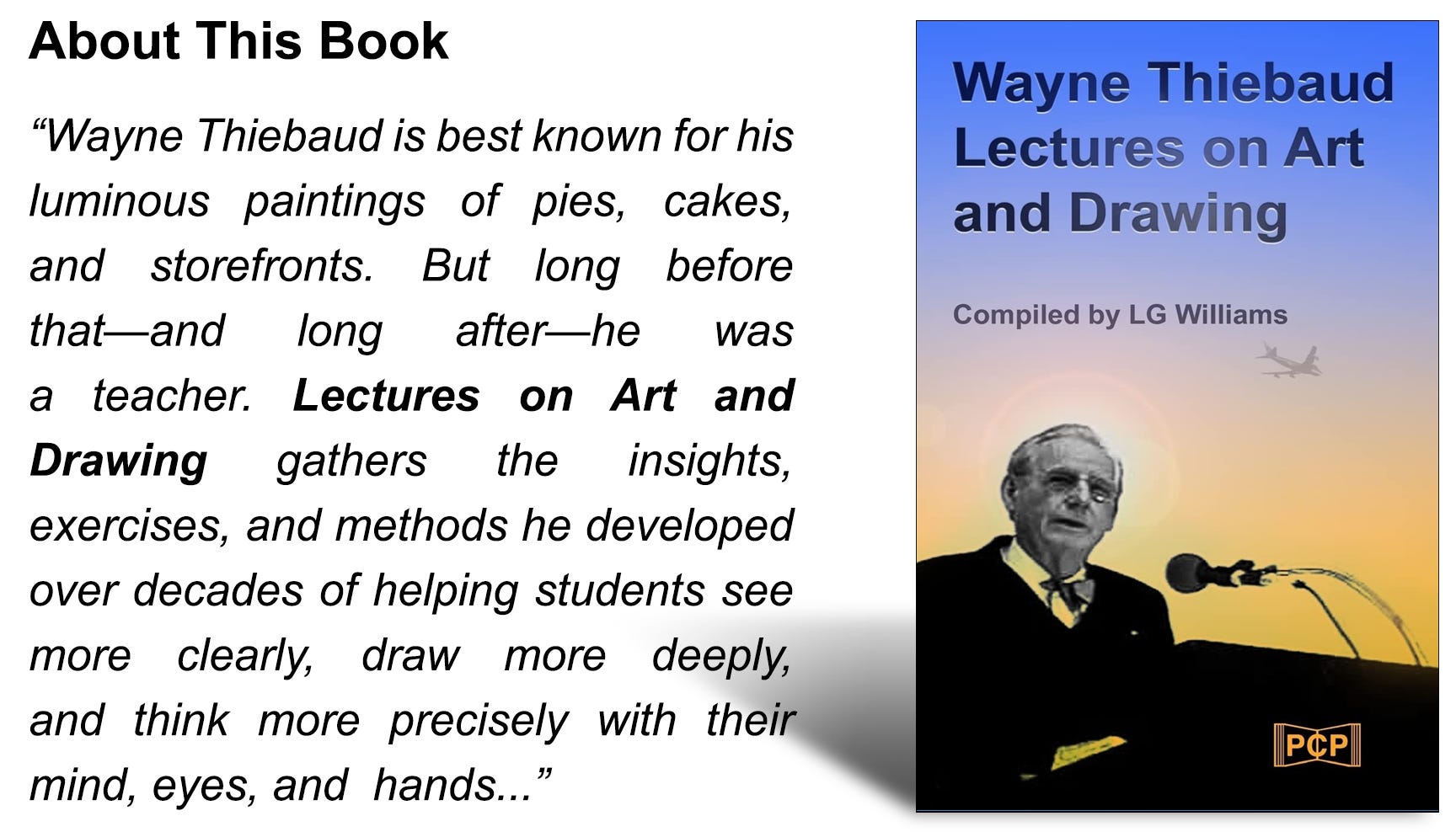
Wayne Thiebaud Lectures
on Art and Drawing
by Wayne Thiebaud, LG Williams (Editor)
PCP Press | Available now on Amazon | View Sample
"Drawing must be based on need—meaninglessness is drawing’s greatest disease."
Wayne Thiebaud, renowned for his luminous still lifes of cakes and pies, was not only a celebrated figure in postwar American art but also a passionate educator. For over forty years at the University of California, Davis, he inspired generations of students with his belief that drawing is more than a technical skill—it is a way of seeing, thinking, and understanding the world. Thiebaud’s teaching emphasized the discipline and joy of visual observation, regularly connecting classroom exercises to his own creative process.
Lectures on Art and Drawing is a unique collection, gathering for the first time a wide selection of student notes from Thiebaud’s foundational courses—Beginning Drawing, Descriptive Drawing, Life Drawing, Beginning Painting, Printmaking, and Theory and Criticism. These notes, refined through decades of studio practice and classroom insight, are concise, methodical, and surprisingly expansive. They guide readers from basic mark-making to the psychology of space, from compositional analysis to aesthetic judgment, offering a practical studio companion for artists, students, and teachers alike.
At a time when art education increasingly favors theory over practice, this book offers a rare glimpse into a studio culture built on observation, repetition, and creative discipline. Lectures on Art and Drawing is not just a handbook for students—it is a record of one of the twentieth century’s most beloved painters in his other great role: that of a generous and exacting teacher.
Book Contents
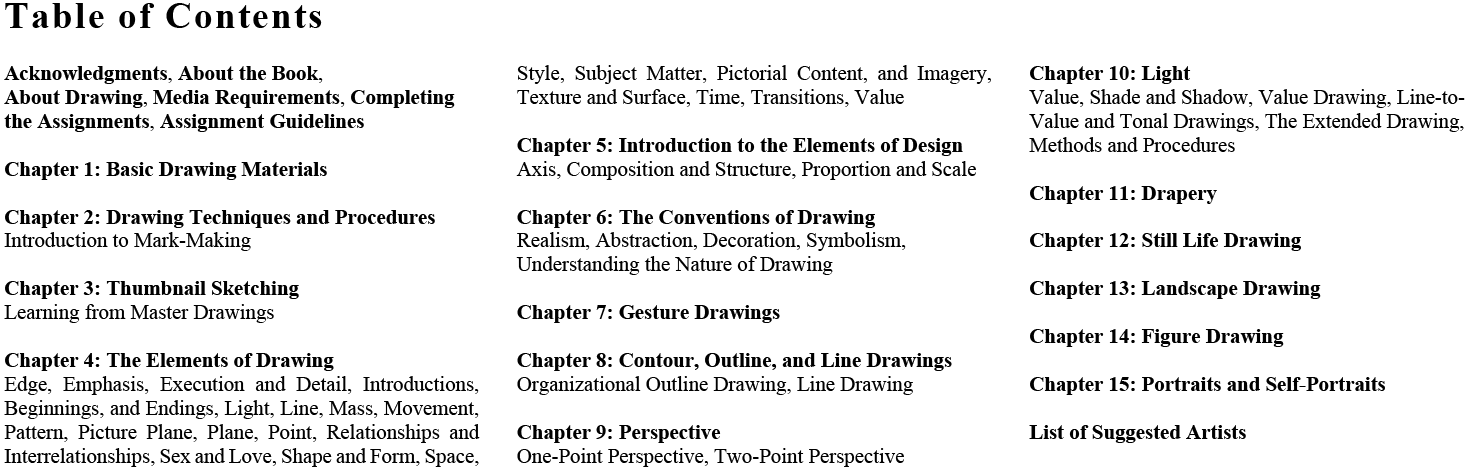
Wayne Thiebaud Lectures on Art and Drawing is a comprehensive, historic compilation from decades of classroom instruction by one of America’s most beloved painters. Spanning over 270 pages, the book brings together lecture notes, assignments, definitions, and drawing exercises from Thiebaud’s foundational courses at UC Davis—including Beginning Drawing, Life Drawing, Painting, Printmaking, and Theory and Criticism.
The structure is modular and accumulative, designed like a rigorous art school curriculum. The book contains well over 100 assignments and exercises, ranging from rapid gesture drawings and mark-making experiments to extended compositional studies and theoretical reflections on style, space, and form. Each section builds on the last, offering both conceptual depth and practical guidance, all delivered in Thiebaud’s characteristically clear, generous tone.
This is not a glossy survey or coffee table book. It is a working handbook—filled with prompts, procedures, and principles—designed to train the hand, sharpen perception, and foster creative independence.
“You are not alone. Cultivate heroes. Frequent and gaze upon grand artistic accomplishments.”
Selected Quotes
“Only talent matters—muster visual inventiveness.”
(A blunt affirmation of artistic responsibility: originality is earned, not assumed.)“Drawing must be based on need—meaninglessness is drawing’s greatest disease.”
(A declaration of artistic ethics. Drawing must be motivated by inquiry, not mere activity.)“Could you have done better? Could you define what the drawing is about? Was it a first-rate work by a first-rate artist? Or a second-rate work by a first-rate artist?”
(This is not reverence—it’s interrogation. Students are taught to judge, not worship.)
“Drawing can inform your experience and provide you with never-before-seen images of personal truths.”
(Drawing becomes an epistemological act—a way of knowing, not just showing.)“Exercise your greatest gift—imaginative freedom. Investigate the imperative to be courageous. Explore the untried and the unknown.”
(Creativity demands risk, not just novelty. Courage is the artist’s essential tool.)“Surround yourself with artistic genius—copy masterpieces frequently…Unravel their inexplicable details and processes. Bring their lessons and discoveries into your next work.”
(Copying is not derivative—it’s apprenticeship through attention.)“Think of everything you can to be creative. Demand of each drawing that it compel us to look and reexamine ourselves in new ways.”
(Drawing is a provocation, not a product. It should disrupt perception.)“Drawing requires artistic combination and recombination… reassertion and self-reflection: Draw the same subject over and over again.”
(Repetition becomes methodology—a way to see more and presume less.)“Surprise yourself with your own seeing. Be ready to receive something unexpected from the mark you just made.”
(Drawing is a dialogue, not a monologue. The hand teaches the eye.)“Success is not to be found in having an answer, but in managing failure.”
(For Thiebaud, artistic progress comes through iteration, not resolution.)“How can you image understanding? How can you shape experience? How can you draw what you know?”
(A philosophical prompt that launches the reader into the epistemology of mark-making.)
Selected Assignments
“Make a drawing by placing a handful of coins on this sheet of paper. Trace the entire mass and fill in the surrounding area.”
(A surreal prompt that turns composition into excavation.)“Draw the space around the object—its silhouette—rather than the object itself.”
(A lesson in negative space and perceptual inversion, this disrupts object-centric habits and sharpens spatial logic.)
“Draw a white coffee cup or paper cup on a white sheet of paper using only the tonal value drawing technique.”
(A masterclass in subtle value observation and the problem of near-invisibility.)“Draw an image that mixes conventions that are incompatible.”
(Forces the student to confront style, contradiction, and coherence head-on.)“If your life could be presented in a symbolic form, what would it look like?”
(Introspective and open-ended—veering toward performance art or autobiography.)“Take the human figure and abstract it in terms of a specific ideology.”
(Asks the student to confront representation, identity, and meaning all at once.)
“Draw 10 different surfaces using different media: fur, satin, metal, wood, paper, plastic, hair, cloth, grass, and glass.”
(A materialist test of rendering skill, textural variation, and graphic adaptability.)
Book Details:
Format: B&W, Paperback
Page Count: 272 pages
Language: English
Dimensions: Approx. 5.5 × 8.5”
ISBN: 1985865432
3rd Edition Publication Date: February 23, 2015
Publisher: PCP Press
About Wayne Thiebaud
Wayne Thiebaud (1920–2021) was an American painter, draftsman, and educator best known for his luminous depictions of cakes, pies, gumball machines, and other everyday objects. Often associated with Pop Art—though he resisted the label—Thiebaud’s work blended realism, abstraction, and painterly precision to explore color, light, and memory. He taught for over four decades at the University of California, Davis, where his legendary drawing and painting courses influenced generations of artists. Thiebaud’s work has been exhibited internationally and is held in major collections including the Whitney Museum of American Art, SFMOMA, and the Art Institute of Chicago. His legacy rests not only in his celebrated paintings but also in his lifelong commitment to the craft and teaching of art.
About LG Williams
LG Williams is a Los Angeles–based artist whose positions have included Endowed University Instructor at the Academy of Art University, Robert Hughes Distinguished Visual Artist-in-Residence at The Lodge in Hollywood, and Emmy Hennings Distinguished Professor at D(D).DDDD University. His work has been shown internationally—including at the Internet Pavilion of La Biennale di Venezia—and has been featured in Artforum, The New York Times, The Guardian, Times Literary Supplement, La Stampa, Purple Diary, Mousse Magazine, and The Brooklyn Rail.
Home | Top | Previous | News | Full Catalogue
About PCP Press
PCP Press is an independent publisher of avant-garde books and insurgent authors. Founded in 1990 in San Francisco to champion subversive and esoteric art, PCP has since published books, special editions, and rare interventions with figures such as Wally Hedrick, Wayne Thiebaud, Dave Hickey, Raymond Pettibon, Bryan Reynolds, and LG Williams.
More information and titles can be found at www.pcppress.com
