
Blocking For Godot: A Four-Volume Gesture at the Beyond
Where Possibility Becomes the Last Remaining Form of Art

Unable To View Images? Click Here
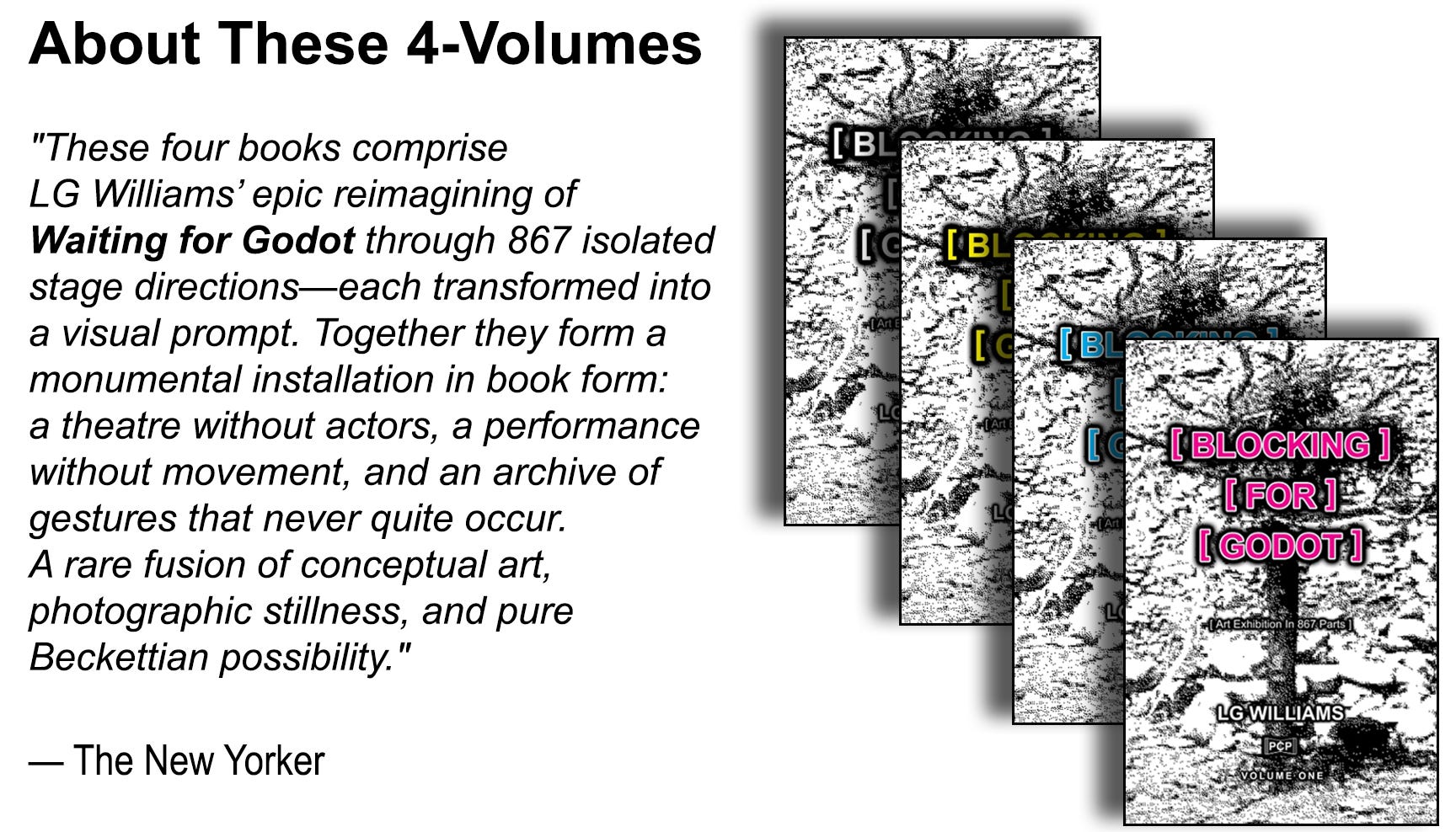
Blocking For Godot: 4-Volume Set
by LG Williams
PCP Press | Available now on Amazon | Direct links provided below
There are works of art that extend a tradition, and works that exhaust it. Blocking For Godot belongs to the latter category.
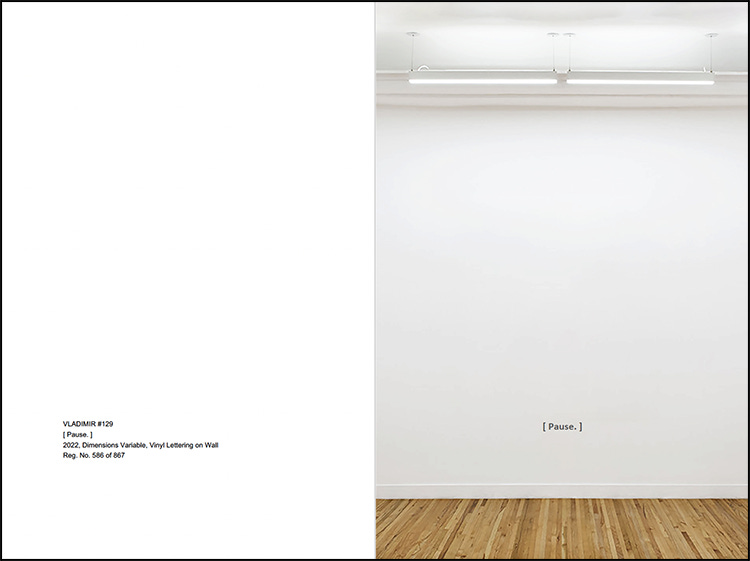
Four volumes. 867 blocking instructions. Every stage direction from Beckett’s play, isolated and illustrated.
By converting every directive from Waiting for Godot into an image, LG Williams transforms theatrical notation into signage—a visual prompt that completes the circuit from Samuel Beckett’s embodied thought back to the viewer’s. A circuitous narration told entirely through gesture. Stripped of dialogue, liberated from plot, evacuated of dramatic resolution.
The project asks the question that defines modernist experimentation: what is the minimum unit that still contains the essence of the form? Pollock isolated the gesture without the paint. Photography froze a single instant from infinity’s flow. The novel fantasized about compressing itself into a single word. Williams isolates the blocking instruction from the theatre. Can one gesture from an epic play itself be epic? Can a single directive—”He sits,” “They wait”—contain the existential weight of Beckett’s complete vision? The answer across four volumes: yes, but only if you examine all 867 of them. Each instruction becomes a fragment that holds the whole, as if every blocking notation were a hologram of the play’s total architecture.
This is theatre performed without speech, a play delivered only through the choreography of bodies moving through space. Pure action without actors. Pure theatre without performance. This is not language falling away but language reduced to its operational core: narrative evaporates, and only the grammar of possibility remains.
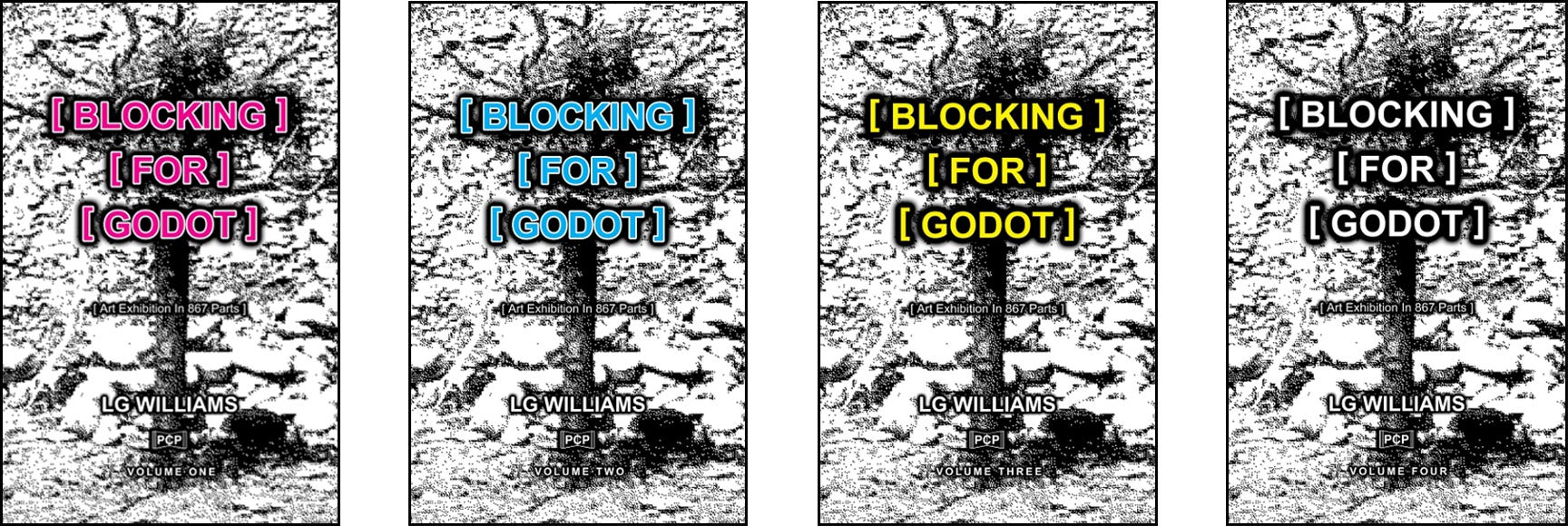
The four volumes operate like a slow-motion dissection of gesture itself. Each blocking instruction—originally the most utilitarian unit of theatrical notation—becomes an image, a prompt, a command, a fossilized trace of a motion that may or may not occur. The “blocking” becomes its own theatre; the book becomes a stage; the reader becomes the actor whose body must complete what the text proposes. The project extends the long line of attempts to think the text–image–body triangle: not illustration, not documentation, but something more elemental, where the smallest directive (”He goes,” “They wait,” “She sits”) becomes the most precious unit of narrative time.
If gesture was once tied to paint—Pollock flinging enamel, De Kooning dragging the brush, Kline carving force through black—here gesture survives, but its medium evaporates. Action Painting without paint. Choreography without dancers. Cinema without frames. Photography without exposure. The movement remains even as the substance disappears. A gesture with nothing left to carry it becomes, paradoxically, the most radical kind of gesture.
The project marks a return to the problem of the interstice—the gap between image and instruction, between motion and its notation. Photography canonized the instant by freezing it. Film extended the instant into duration. Williams reverses both: he freezes the instruction rather than the action, preserving not the gesture itself but the possibility of a gesture. What is documented is not the event but its possibility. A kind of pre-photographic photography—the image as an index of something that has not yet happened.
This is where a deeper lineage emerges. At the once-legendary MFA program at the University of California, Davis, a great artist appeared roughly once every twenty years, as if the soil demanded a long fallow period before yielding another. One generation produced a young sculptor who turned the everyday body—walking, falling, speaking, shouting—into the raw material of art. Nearly two decades later, another alumnus returns to those questions, but empties the body out entirely, keeping only its instructions. If earlier experiments tested the limits of behaviour, Williams tests the limits of notation itself. The clown once shouted “Get out of my life!” while performing absurd actions in front of the camera; here, the absurdity is quieter, more terminal, and more rigorously semiotic, as if the performance has ended and only the stage directions remain.
Wittgenstein suggested that understanding a language is understanding a practice—that meaning lives in use, not in abstraction. Blocking For Godot pushes that axiom to its outer edge by offering a language of actions without the actions themselves. The blocking instructions form a grammar, but their meaning hangs suspended, unfulfilled. This is not a book you read; it is a book that waits for you. The volumes create a theatre that cannot be staged, a performance that occurs only in the reader’s internal sense of embodiment—an art of latent gestures.
The result is an interdisciplinary convergence: infective gallery and museum signage, a conceptual score, a photographic thought experiment, theatrical archaeology, and a philosophical inquiry into what remains of the human when narrative recedes and only the grammar of possibility remains. For possibility is the sovereign condition of every art—ancient or modern—the elemental arena where inspiration precedes gesture, gesture precedes action, meaning precedes language, and hope survives its own exhaustion. It is, in short, a Hail Mary for capital-A Art, a reminder that experimentation is still possible even when the traditional materials have been evacuated. The books affirm that gesture—unpainted, unstaged, unperformed—may still be the last refuge of artistic freedom.
Across four volumes, every prompt becomes a tiny theatre of hesitation: the perpetual almost-action, the suspended narrative, the inextinguishable waiting that defines modern life. These books form the most complete articulation of that condition yet attempted. A monumental installation disguised as a set of paperbacks. A gesamtkunstwerk made entirely out of omissions. A performance whose only actors are the instructions that remain after the actors have left.
In the end, Blocking For Godot is not about Beckett, nor about theatre, nor about images or photography, nor about performance. It is about the fragile afterlife of gesture in a world where meaning leaks from every surface. It is an archive of movements that never occur, a choreography of what-ifs, the ghost of a performance that has already begun and will never end.
It is, unmistakably, the work of an artist betting everything on the possibility that the smallest directive—wait—might still produce the largest reverberation.
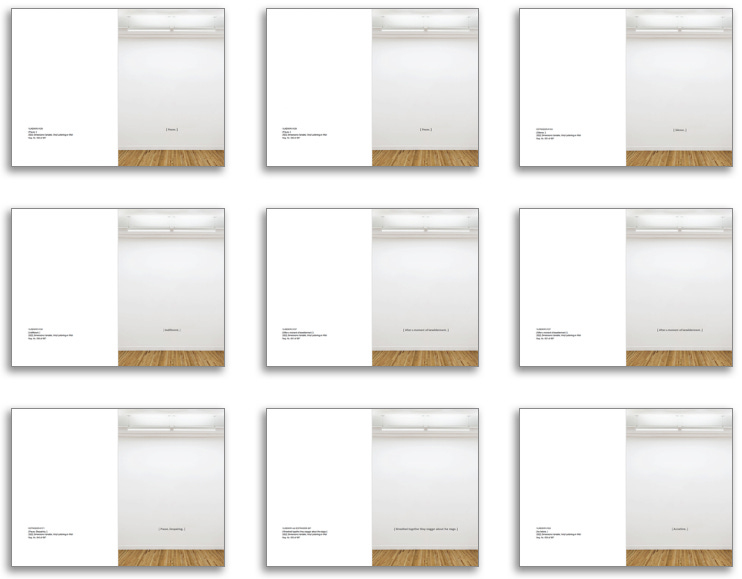
Selected Plates From The 4-Volumes
From The Back Cover
Blocking For Godot is LG Williams’s four-volume, 867-part transformation of every blocking instruction from Beckett’s Waiting for Godot into visual form. By converting theatrical directives into images, Williams turns notation into a new kind of conceptual signage—an artwork where narrative evaporates and only the grammar of possibility remains. This is theatre without speech, performance without actors, and gesture without movement: a slow-motion archive of unrealized action.
Across these volumes, each instruction becomes a self-contained world—a fragment that holds the whole, as if every directive were a hologram of the play’s architecture. What began as Beckett’s stage directions reemerges here as a photographic thought experiment, a conceptual score, and a piece of environmental museology. The result is a rare convergence of visual art, theatrical archaeology, and philosophical inquiry into the limits of meaning when language recedes and only potential remains.
More than documentation, Blocking For Godot is a meditation on waiting, hesitation, and the fragile afterlife of gesture in contemporary life. Williams freezes not the action but the possibility of action, offering a monumental installation disguised as a set of books. It is an epic of latent movement, a choreography of what-ifs, and the work of an artist betting everything on the idea that the smallest directive—wait—can still produce the largest reverberation.
Individual Book Details
Blocking Godot: The Art of the Exhibition (Volume One), Full Color, Paperback, 104 pages, 8.5 x 11 inches, ISBN: 979-8846955356, PCP Press, 1st Edition August 24, 2022 — Available now on Amazon | View Sample
Blocking Godot: The Art of the Exhibition (Volume Two), Full Color, Paperback, 104 pages, 8.5 x 11 inches, ISBN: 979-8846962590, PCP Press, 1st Edition August 24, 2022 — Available now on Amazon | View Sample
Blocking Godot: The Art of the Exhibition (Volume Three), Full Color, Paperback, 112 pages, 8.5 x 11 inches, ISBN: 979-8846974333, PCP Press, 1st Edition August 24, 2022 — Available now on Amazon | View Sample
Blocking Godot: The Art of the Exhibition (Volume Four-Index ), Black and White, Paperback, 128 pages, 8.5 x 11 inches, ISBN: 979-8846989979, PCP Press, 1st Edition August 26, 2022 — Available now on Amazon | View Sample
About LG Williams
LG Williams is a Los Angeles–based artist whose positions have included Endowed University Instructor at the Academy of Art University, Robert Hughes Distinguished Visual Artist-in-Residence at The Lodge in Hollywood, and Emmy Hennings Distinguished Professor at D(D).DDDD University. His work has been shown internationally—including at the Internet Pavilion of La Biennale di Venezia—and has been featured in Artforum, The New York Times, The Guardian, Times Literary Supplement, La Stampa, Purple Diary, Mousse Magazine, and The Brooklyn Rail.
Home | Top | Previous | News | Full Catalogue
About PCP Press
PCP Press is an independent publisher of avant-garde books and insurgent authors. Founded in 1990 in San Francisco to champion subversive and esoteric art, PCP has since published books, special editions, and rare interventions with figures such as Wally Hedrick, Wayne Thiebaud, Dave Hickey, Raymond Pettibon, Bryan Reynolds, and LG Williams.
More information and titles can be found at www.pcppress.com
